
Why this guide matters: clarity, care, and trustworthy guidance on NPD treatment
Many people hear the word "narcissism" but don’t always know what it truly means. It can be very confusing when you or someone you care about might be dealing with something serious like narcissistic personality disorder (NPD). Because of this confusion, understanding narcissistic personality disorder treatment is very important.
People often look for help with NPD, but it’s not always clear what getting treatment really involves. NPD is a mental health condition where a person has a long-lasting pattern of grandiosity, a strong need for others to admire them, and a lack of empathy for other people’s feelings. To be diagnosed with NPD, someone needs to show at least five key traits, such as believing they are special or exaggerating their own achievements, as explained by experts at Harvard Health. This guide is here to help make sense of that confusion in 2026.

We want to give you simple, honest information about what NPD is and how doctors think about narcissistic personality disorder treatment. This guide will help you understand how mental health experts approach helping people with NPD. Just like it’s important to understand other complex conditions, like learning about Multiple Personality Disorder Facts, Myths, and Legal Rights, this guide aims to make NPD clear.
You will also find helpful ideas for people affected by NPD, including their loved ones, so they can find support and better ways to cope. Our goal is to offer clear, careful, and trustworthy guidance for everyone looking for answers. If you want to stay updated on our latest insights, wellness tips, and community opportunities, we invite you to Join The Newsletter.
What is narcissistic personality disorder (NPD)? Key features and myths
We talked about how confusing NPD can be. Now, let’s look closer at what narcissistic personality disorder really is. It’s important to know the difference between just having a strong personality and having a real mental health condition. Experts make sure to use careful language to avoid hurting feelings or making people feel ashamed when talking about mental health. For example, guides on writing about mental health suggest focusing on the person, not just the diagnosis, and using words that build connection. A good way to think about it is that we describe people’s feelings and actions carefully, rather than using harsh labels, as recommended by mental health communication guides like those from Psych Hub’s Communication Guide for Behavioral Health Content.
NPD is a real mental health condition. It means a person has a lasting way of thinking and acting that includes:
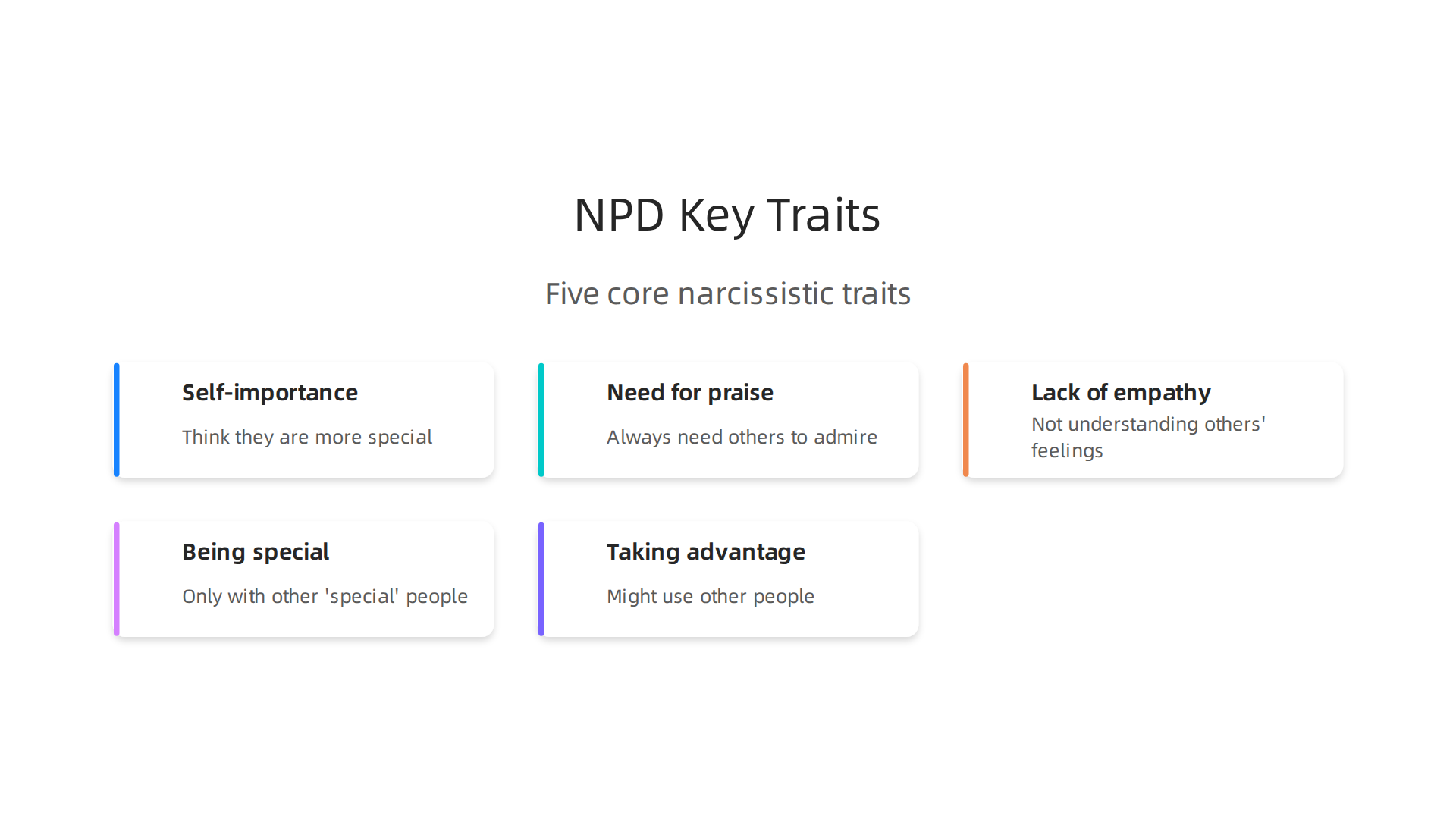
- Big ideas of self-importance: They might think they are much more special or important than others, even without showing achievements to match.
- A strong need for praise: They always need others to admire them a lot.
- Not understanding others’ feelings: This is called a lack of empathy. They find it hard to see or care about what other people are going through.
- Belief in being special: They feel they should only hang out with other "special" people or groups.
- Taking advantage of others: They might use other people to get what they want.
To be diagnosed with NPD, a person needs to show at least five of these kinds of traits. It’s a pattern that has to be there for a long time and cause problems in their life, such as in friendships, work, or school. This is what helps doctors tell it apart from just a few "bad days" or being overly confident, as explained by health groups like the Cleveland Clinic.
Busting common myths about NPD
There are many wrong ideas about NPD. Let’s clear some of them up:
- Myth 1: Being confident means you have NPD. Not true! Being confident and feeling good about yourself is healthy. A person with NPD has an unhealthy kind of self-importance that hurts their relationships and life, not helps it.
- Myth 2: All people with NPD are mean or abusive. While some actions by people with NPD can be harmful, it’s not fair to say everyone with the condition is abusive. The term "narcissist" is often used loosely in everyday talk, but the clinical condition is much more complex. This condition impacts the person and those around them, and understanding narcissistic personality disorder treatment is key to finding help.
- Myth 3: People with NPD cannot get better. This is also not true. While it can be a hard condition to treat because it affects a person’s core ways of thinking, many forms of therapy can help.
People with NPD often have other mental health challenges too. Sometimes, they might also experience things like deep feelings of being detached from themselves or their surroundings, which is known as depersonalization disorder. Understanding these other conditions is important for getting the right kind of help. Mental health experts work to understand each person’s unique situation to find the best path forward.
How is NPD diagnosed? Screening, assessment, and when to seek evaluation
Figuring out if someone has Narcissistic Personality Disorder (NPD) is not something you can do with a quick online quiz. It’s a careful process that only trained mental health experts can do. They use a few important steps to make sure they get it right.
The path to a diagnosis
- Seeing a Mental Health Professional: The first step is to talk to a doctor or therapist who specializes in mental health.
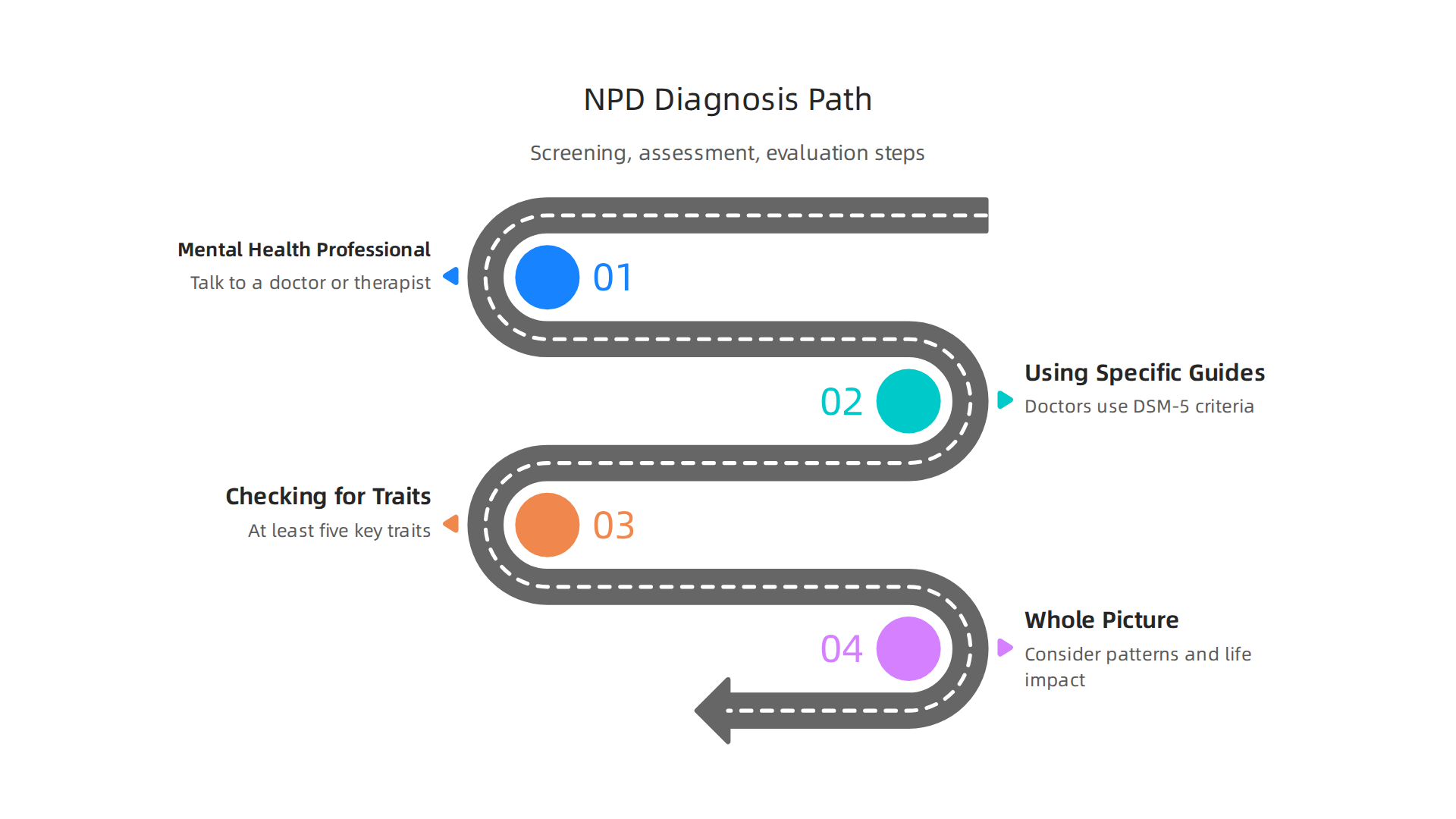
They will have a deep conversation with the person. This is called a clinical interview. During this talk, they will ask about thoughts, feelings, and how the person acts in different situations.
2. Using Specific Guides: To make a correct diagnosis, doctors use a guide called the Diagnostic and Statistical Manual of Mental Disorders, or DSM-5. This book lists all the signs a person needs to show to be diagnosed with a mental health condition. For NPD, the guide looks for a long-standing pattern of grandiosity, a strong need for admiration, and not being able to understand others’ feelings. Experts like those from StatPearls on Narcissistic Personality Disorder agree that a consistent pattern of these traits is key.
3. Checking for Specific Traits: As we talked about before, a person needs to show at least five out of nine specific traits to get an NPD diagnosis. These can include things like having a huge sense of self-importance or taking advantage of others. Finding these traits is part of a detailed assessment, as explained in a guide to 9 Signs of Narcissistic Personality Disorder.
4. Looking at the Whole Picture: The expert will also consider how long these patterns have been present and how much they affect the person’s life, like their friendships, family, or work.
What about other conditions?
Sometimes, other conditions can look a bit like NPD. Doctors call this "differential diagnosis," which means they rule out other possible problems. For example, some people might wonder about schizotypal personality disorder symptoms because it also involves unusual ways of thinking. A mental health professional helps sort through these different possibilities.
It’s also common for people with NPD to have other mental health challenges at the same time. These might include anxiety, depression, or feelings of being detached from themselves, similar to depersonalization disorder. This is why a full and careful evaluation is so important. Getting the right diagnosis is the first step towards finding effective narcissistic personality disorder treatment. Organizations like Camber Mental Health and Sagent Behavioral Health focus on providing thorough evaluations for complex mental health needs.
When should someone seek evaluation?
It can be hard to know when to seek help. If you or someone you know shows many of the signs of NPD, and these patterns are causing ongoing problems in their life, it’s a good idea to talk to a mental health professional.

Here are some practical signs that suggest a clinical evaluation might be helpful:
- Relationship Problems: Always having big fights or broken friendships because of how someone acts.
- Trouble at Work or School: Not being able to keep a job or finish school because of conflicts or a constant need for special treatment.
- Feeling Unhappy: Even if someone acts confident, they might feel really empty, sad, or angry inside.
- Harmful Actions: If their actions hurt others, even if they don’t mean to, it’s a sign to get help.
- A Desire for Change: Sometimes, the person themselves feels stuck and wants things to be different. This is a very good reason to seek help.
Remember, seeking evaluation is a brave step toward understanding what’s going on and finding the right support.
Want to stay informed about new articles, community projects, and ways to participate? Join The Newsletter and become part of our growing movement.
Overview of treatment approaches: psychotherapy, goals, and expected timelines
After getting a clear picture of what’s happening with a diagnosis, the next big step is to start narcissistic personality disorder treatment. This type of treatment usually focuses on talking with a therapist, which we call psychotherapy. There are no special pills approved by doctors to treat NPD directly. However, if someone also feels very sad or worried, doctors might give them medicine for those feelings, like for depression or anxiety, alongside talk therapy.
How psychotherapy helps
Different kinds of talk therapy can help people with NPD. These therapies work to help people understand themselves better and change behaviors that cause problems in their lives.
Here are some common types:
- Psychodynamic-informed therapy: This therapy helps people look at how their past experiences might be shaping their feelings and actions now. It helps them see why they feel the need to be admired or why they struggle with understanding others.
- Schema therapy: This approach focuses on deep-seated patterns of thinking and behaving that started in childhood. It helps people change these unhealthy patterns. Studies have looked at how Unified Protocol vs. Schema-Focused Therapy compares to other ways of helping people with narcissism.
- CBT-derived methods: These are like tools from Cognitive Behavioral Therapy (CBT). They help people spot unhelpful thoughts and change them. They also help people learn new ways to act in situations. Experts say a mix of different types of therapy, including CBT, can be helpful for managing narcissistic personality disorder.
- Mentalization-based treatment (MBT): This therapy helps people understand their own feelings and thoughts, and also the feelings and thoughts of others. It’s like learning to see the world from different viewpoints. This approach can be very promising for dealing with issues linked to narcissism, as discussed in Mentalization-Based Treatment: A Promising Approach for Pathological Narcissism.
- Other therapies like Dialectical Behavior Therapy (DBT) and Transference-Focused Psychotherapy can also be useful to improve how a person functions in their daily life and relationships, according to Narcissistic Personality Disorder Across Types of Therapy.
What treatment aims to change
The main goals of narcissistic personality disorder treatment are not to change who a person is, but to help them live a happier, more balanced life. This means:
- Building better relationships: Learning to have more real and lasting connections with others.
- Managing feelings: Finding healthy ways to deal with sadness, anger, and feelings of emptiness.
- Understanding others: Getting better at seeing things from another person’s side, which is called empathy.
- Less focus on self-importance: Slowly letting go of the need for constant praise and attention.
- Improving daily life: Doing better at work or school, and having more stable friendships.
What to expect and how long it takes
It’s important to know that narcissistic personality disorder treatment is a marathon, not a sprint. This kind of therapy takes time and a lot of effort. It can often take a long time, sometimes 2.5 to 5 years, for people to show big improvements.

Research shows that after treatment, patients can improve, no longer meet DSM-5 criteria for NPD, and show better psychosocial functioning.
Here’s what is realistic:
- Progress is slow and steady: You won’t see huge changes overnight. It’s a gradual process, like a slow climb up a mountain.
- Real improvements can happen: Studies show that with the right treatment, people can get much better. They might have fewer NPD signs and better relationships and work lives, as outlined in Narcissistic Personality Disorder: Patterns, Processes, and Outcomes.
- It’s about changing patterns: The aim is to change harmful ways of thinking and acting, not to erase who the person is. While some core traits might remain, their impact on life can become much smaller.
Doctors measure progress by looking at things like how stable someone’s relationships are, if they can keep a job, how well they manage their emotions, and if they show fewer of the specific NPD traits over time. It’s about helping people find new ways to connect and feel good about themselves without needing to put others down or always be the center of attention.
To help stay on track with personal goals, whether for therapy or daily life, an accountability partner app can be a good tool. It can provide support and motivation for long-term changes.
Medications and adjunctive treatments: what role do they play?
While talk therapy is the main narcissistic personality disorder treatment, you might wonder if medicines have a part to play. It’s important to know that there are no specific medications made just for NPD itself. Instead, doctors sometimes prescribe medicine to help with other problems that often come along with NPD. These can include feelings of sadness (depression), worry (anxiety), or even very strong mood swings.
How medications help with other symptoms
When someone has NPD, they might also struggle with other mental health issues. For example, they could experience depression, anxiety, panic attacks, or even symptoms like depersonalization disorder (feeling detached from themselves). Medications can be very helpful for these extra symptoms.
Here’s how different types of medicine might be used:
- Antidepressants: These can help lift a person’s mood if they are feeling very sad or hopeless.
- Anti-anxiety medications: If someone feels very worried or has panic attacks, these medicines can help calm them down.
- Mood stabilizers: These might be used if a person has big ups and downs in their mood.
- Antipsychotics: In rare cases, if someone is having very strong thoughts that aren’t based in reality or struggling with severe anger or impulsive actions, a low dose of an antipsychotic might be considered. Some studies show that antipsychotics can help with depressive and psychotic-dissociative symptoms in personality disorders generally, though the evidence is not strong for overall improvement of the disorder itself secondary analysis of the Cochrane systematic review with ….
It’s clear that medicine is usually an extra helper, not the main focus, for personality disorders. Experts agree that any medication for personality disorders should be a short-term solution aimed at specific problems, and it should always be used alongside talk therapy, not instead of it Pharmacological Management of Borderline Personality …. In fact, no medication has been officially approved to treat personality disorders directly World Federation of Societies of Biological Psychiatry (WFSBP) Guidelines for Biological Treatment of Personality Disorders.
If you are experiencing symptoms of depression or anxiety, knowing about free online screenings can be a helpful first step in understanding what’s going on. You can find out more about mental health America offers free online screenings for depression and anxiety.
The importance of integrated care
When someone takes medicine for symptoms related to NPD, it’s very important that their prescriber (the doctor who gives them the medicine) works closely with their therapist. This is called integrated care. Both professionals need to talk to each other to make sure the treatment plan makes sense and works well together. For example, a doctor might suggest a specific medication, and a therapist at a place like Camber Mental Health or Sagent Behavioral Health would then help the person understand how the medication is affecting them and how it fits into their overall narcissistic personality disorder treatment goals.
Benefits and risks to consider
Benefits:
- Symptom relief: Medications can help ease tough symptoms like extreme sadness, worry, or anger, making it easier to focus on therapy.
- Better daily functioning: When symptoms are calmer, people can often manage their daily lives better, improving relationships and work.
Risks:
- Side effects: All medicines can have side effects, and some people might not like how they feel on them.
- Polypharmacy: This means taking many different medications at once. It can be tricky and lead to more side effects or problems between the drugs.
- Not a cure: It’s key to remember that medicine helps manage symptoms but doesn’t "cure" NPD. The deep changes come from therapy.
Working with a team of mental health professionals who understand personality disorders is vital. They can help you weigh the pros and cons of medication and ensure it’s used safely and effectively as part of your overall narcissistic personality disorder treatment.
If you’re interested in learning more about how to stay informed about new approaches in mental wellness, especially as the landscape of treatment evolves, you can always Join The Newsletter for updates.
Living with or supporting someone who has a personality disorder can be very challenging. It often requires more than just the person receiving narcissistic personality disorder treatment. Partners, family members, and even creators who talk about mental health have important roles.

This section will look at how to communicate better, set limits, and discuss how creators can handle these topics responsibly.
How to talk and set limits with someone who has NPD
It can be hard to have good conversations with someone who has Narcissistic Personality Disorder (NPD). They might struggle to see things from another person’s view or to understand how their actions affect others. But with clear strategies, you can make things a bit easier for everyone.
Here are some tips:
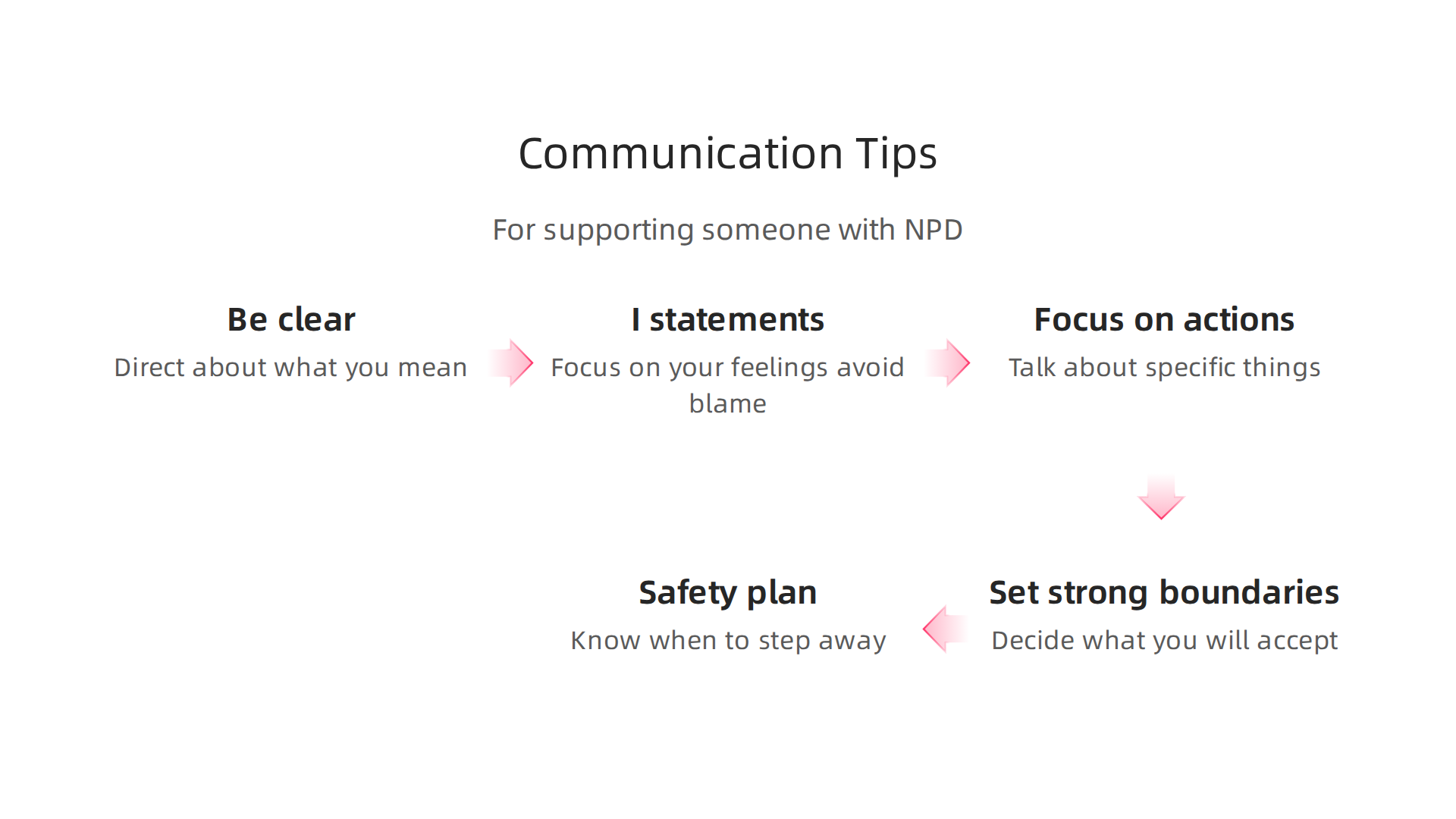
- Be clear and calm: When you talk, try to be direct about what you mean. Stay calm, even if the other person gets upset.
- Use "I" statements: Instead of saying "You always…" try "I feel [emotion] when [specific action happens]." This focuses on your feelings and avoids blame.
- Focus on actions, not labels: Talk about specific things that happened, rather than calling the person names or diagnosing them yourself. For example, "When you interrupt me, I feel unheard," is better than "You’re so narcissistic."
- Set strong boundaries: This is super important. Boundaries are like invisible lines that protect you. You need to decide what you will and won’t accept in your interactions. For example, "I will talk about this later when we can both be calm," or "I cannot continue this conversation if you raise your voice." It’s vital to stick to these limits. Studies suggest that clear boundaries help in talking with people who have personality disorders, offering support but also defining your role’s limits Communicating with people with Personality Disorders.
- Have a safety plan: If things get very heated or you feel unsafe, know when and how to step away. This might mean having a trusted friend to call or a safe place to go. Your emotional and physical safety matters most.
Sometimes, people close to someone with a personality disorder also need support. Peer support groups, where people share similar experiences, can be very helpful. These groups connect individuals who have experienced similar problems, offering a chance to share, learn, and feel less alone From Social Network to Peer Support Network: Opportunities to Explore…. Such support can reduce feelings of loneliness and make you feel stronger Is peer support beneficial for individuals with borderline ….
Creators and brands: addressing personality disorders responsibly
For creators, writers, or brands discussing mental health, especially personality disorders like NPD or depersonalization disorder, it’s key to do so with care and responsibility. Your words can help or harm.
Here’s how to do it right:
- Use person-first language: Always put the person before the diagnosis. Say "a person with NPD" instead of "an NPD." This reminds everyone that the disorder is part of a person, not their whole identity PSYCH HUB’S COMMUNICATION GUIDE FOR BEHAVIORAL HEALTH CONTENT.
- Avoid stereotypes: Don’t use words like "crazy," "mad," or "maniac" when talking about mental health. These words can be hurtful and misleading. Describe feelings and behaviors accurately and with respect.
- Show different experiences: Mental health journeys are not all the same. Show people coping, getting better, and living full lives, not just struggling. This helps to give a more complete and hopeful picture Home – Mental Health.
- Include warnings and resources: If your content talks about sensitive topics, add a content warning at the start. Also, always share information about where people can find help, like helplines or mental health organizations Mental health and media: Trauma-informed reporting guide.
- Build real connection: For creators and brands, focusing on engaging content that promotes positive action and community can turn passive viewing into active participation. When you discuss mental wellness, especially around complex topics, aim to foster real connection and reduce isolation.
Instead of just scrolling, many people are looking for ways to act, create, and share. If you’re a creator or brand looking to build a community around positive action and shared experiences, consider how your work can inspire and empower.
Ready to move beyond passive consumption and engage in meaningful action? You can Join An Experiment and turn curiosity into shared results and recognition.
Living with or supporting someone who has a personality disorder can be very challenging. It often requires more than just the person receiving narcissistic personality disorder treatment. Partners, family members, and even creators who talk about mental health have important roles. This section will look at how to communicate better, set limits, and discuss how creators can handle these topics responsibly.
Self-care and coping for people affected by someone with NPD (and for those with NPD seeking support)
Taking care of yourself is super important when you are close to someone with a Narcissistic Personality Disorder (NPD) or if you are learning to live with NPD yourself. This means having good plans for self-care, looking into peer support, and finding ways to calm your feelings. For those with NPD, it’s also about getting professional help and setting small, helpful goals.
Self-care for families and friends
If you care about someone with NPD, remember to put your own well-being first sometimes. This isn’t selfish; it’s necessary.
- Make time for yourself: Do things you enjoy. Read a book, go for a walk, or spend time with friends who make you feel good.
- Keep your friendships strong: Talk to people you trust. Sharing your feelings can make a big difference. Building true connections can help reduce feelings of loneliness and isolation. For more ways to connect, consider exploring how book clubs offer true connection far beyond endless scrolling.
- Learn about NPD: Knowing more about the disorder can help you understand what’s happening and why. This can make it easier to deal with tough situations.
- Seek your own support: Sometimes, you might need someone outside your daily life to talk to. A therapist can help you find ways to cope and protect your own feelings.
Peer support and shared experiences
Peer support groups are places where people who have similar life experiences come together. These groups can be very helpful for both those supporting someone with NPD and for individuals seeking narcissistic personality disorder treatment for themselves. In these groups, you can share stories, get advice, and feel less alone.
Many studies show that peer support can help people feel more in control of their emotions and less isolated. For instance, programs that use peer workers who have lived experience with personality disorders can really help people feel better and reduce distress Implementation and Outcomes of Peer Support Workers in…. These groups can also help people with conditions like depersonalization disorder to find common ground and support. In fact, some peer groups are designed specifically for people with personality disorders and have shown good results in improving mental health Effectiveness of a co-produced peer group for borderline personality….
Seeking professional help and building routines
For those who have NPD, finding the right support is a brave and important step. Narcissistic personality disorder treatment often involves therapy that helps people understand their feelings and how they interact with others. This can be a long journey, but it’s one that leads to better relationships and a happier life.
Here’s how to get started and keep going:
- Find a good therapist: Look for therapists who specialize in personality disorders. Centers like
Camber Mental HealthorSagent Behavioral Healthmight offer specialized programs. You can also search for therapists online or ask your doctor for a referral. Sometimes, free online screenings can be a good first step to understand your needs. You can explore how Mental Health America offers free online screenings for depression and anxiety. - Set small, realistic goals: Working on NPD is a process. Don’t expect big changes overnight. Focus on small steps, like practicing using "I" statements or trying to understand someone else’s feelings for a few minutes each day.
- Build helpful routines: Regular routines can provide comfort and structure. This might include regular therapy appointments, joining a support group, exercising, or keeping a journal. Using tools like an accountability partner app can also help you stick to these new habits and reach your self-improvement goals.
- Practice emotional regulation: This means learning to manage strong feelings. A therapist can teach you skills like mindfulness or deep breathing. Peer support can also give you ideas from people who have learned to handle their own emotions well.
Remember, taking steps to improve your mental health, whether for yourself or to support a loved one, is a sign of strength. It’s about creating a life that feels more balanced and connected in 2026.
Summary
This article explains narcissistic personality disorder (NPD), why clear information matters, and how clinicians approach treatment in 2026. It defines core NPD traits, clears up common myths, and describes the careful diagnostic process clinicians use—including the DSM criteria and the need for a full assessment. The guide outlines psychotherapy-first approaches (psychodynamic, schema therapy, CBT-derived methods, MBT and others), realistic treatment goals like better relationships and emotional regulation, and expected timelines, noting that meaningful change often takes years. It also covers the limited, symptom-targeted role of medications, the importance of integrated care, and practical strategies for loved ones such as setting boundaries, safety planning, and seeking peer support. Finally, it offers guidance for creators and brands on responsible communication and points readers toward screening tools and resources to find help.