
Introduction
Nearly a century after F. Scott Fitzgerald published The Great Gatsby, it still sits on nightstands, classroom desks, and digital reading lists around the world. You have probably heard someone call it the great American novel. Maybe you read it in high school and felt confused by all the green lights and eyesores. Or maybe you picked it up again recently and realized it hits different now.
Here is the thing: a lot of readers today struggle to see how a story about rich people throwing parties in the 1920s connects to their own lives. We scroll through apps, chase likes, compare our achievements to filtered versions of success, and wonder if we are climbing the right ladder. The novel’s themes of ambition, identity, and hollow wealth feel uncomfortably familiar if you pay attention. Yet many of us miss that connection because classic literature can seem like a dusty museum piece rather than a mirror.
That is where this article comes in. We are going to walk through the lasting power of the great gatsby book together. You will explore its themes, characters, and symbolism, and see how they speak to personal growth and the challenges we face in 2026. Along the way, we will pull in insights from trusted literary analysis, like the way the novel offers a deep critique of the American Dream, and connect those ideas to modern struggles like social comparison and the search for authentic identity.
For anyone ready to trade doom scrolling for something that actually shifts your perspective, discovering a book like The Great Gatsby is a good start.

And if you want a more playful, laugh-out-loud take on similar ideas of curiosity and perspective, you can Explore The Books that blend humor with thoughtful themes.
Now, let us dive in and see why a story from the Roaring Twenties still has so much to say about who we are today.
Why The Great Gatsby Still Matters Today
You might wonder why a novel written nearly a century ago still shows up on bestseller lists and classroom syllabi. The answer is simple: the problems it explores haven’t gone away. In fact, they might feel sharper now than ever.
At first glance, The Great Gatsby looks like a story about a rich guy throwing epic parties to win back a woman. But dig a little deeper, and you find a sharp critique of the American Dream itself. The novel shows us a world where people chase money and status, believing those things will bring happiness. Sound familiar? We live in a time of hustle culture, social media highlight reels, and constant comparison. The green light at the end of Daisy’s dock could easily be a notification on your phone promising something better just out of reach.
One of the biggest reasons the great gatsby book still speaks to us is its honest look at the American Dream. Many of us grew up believing that if we work hard enough, we can achieve anything. But Fitzgerald asked a tough question: what happens when the dream itself is broken? As the SparkNotes analysis of the novel points out, the story is a powerful meditation on the disintegration of the American dream in an era of material excess.
Gatsby works obsessively, bends the rules, and piles up wealth. Yet he never truly belongs. He is never accepted by the old-money crowd. That gap between effort and reward hits different when you see friends with student debt, rising rent, and a job market that feels rigged.
The novel also mirrors our modern anxiety about social class. In the book, characters are divided by geography: East Egg, West Egg, the Valley of Ashes. Today we might call it zip codes, school districts, or neighborhoods with different grocery stores. The wealthy seem to live in a separate world, just like Tom and Daisy. They can retreat into their money and avoid the consequences of their actions. That feeling of being locked out while others float along is something many readers recognize deeply.
But the emotional heart of the story is what makes it unforgettable. Gatsby’s longing for Daisy, his desperate hope that he can repeat the past, and his ultimate loss touch something universal. We have all wanted something we could not have. We have all invested time and energy into a dream that ended in disappointment. Fitzgerald captures that ache so well that readers in 2026 still feel it in their chests.
This is what makes the great gatsby book more than just a classic. It is a mirror. When you read about Gatsby staring across the water at that green light, you might see yourself staring at a goal that keeps moving farther away.

The novel does not offer easy answers. But it does give you company in the struggle.
If you enjoy unpacking the layers of a story like this, you might also like exploring how modern novels build their worlds and characters. Understanding story structure can deepen your appreciation of any book you pick up. Check out this guide to story elements to see how great writers pull off the same magic Fitzgerald mastered.
The Characters That Define an Era: Gatsby, Daisy, Nick, and the Rest
Beyond the big themes, what really makes the great gatsby book stick with you is its cast of characters.
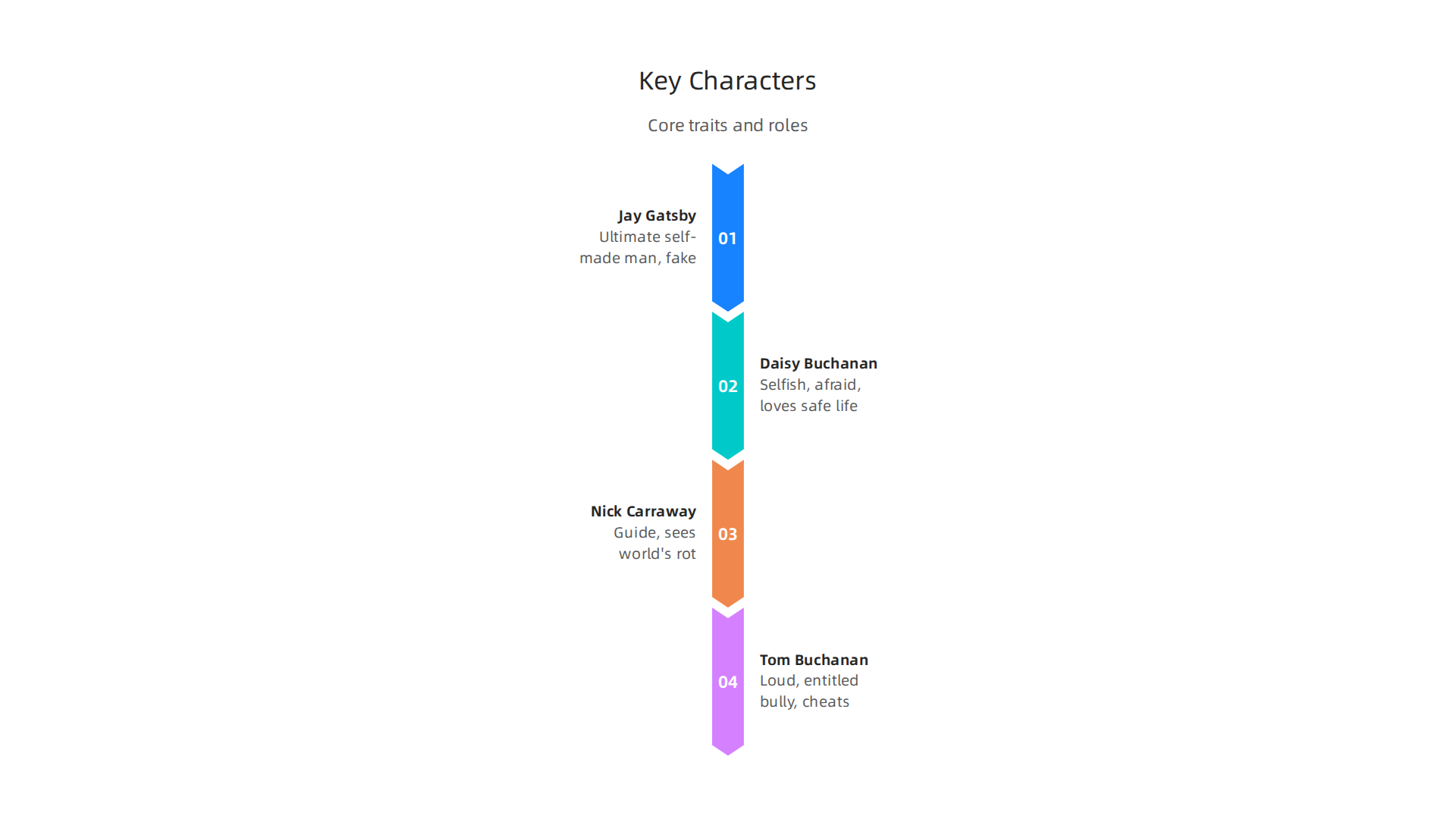
Each one is so real you might feel like you have met them in your own life. Fitzgerald did not write cardboard heroes or villains. He wrote people with deep wants, hidden fears, and messy choices.
Take Jay Gatsby himself. He is the ultimate self-made man, but also the ultimate fake. He builds a whole new identity, throws lavish parties, and fills his house with strangers. Why? To get the attention of one woman, Daisy. Gatsby’s whole life is a performance. He believes that if he just gets enough money and status, he can rewrite the past. As the team at Albert.io explains, Gatsby’s dream tied to the green light is the most powerful symbol in the novel, and it shows how the American Dream can become a trap. You keep reaching for something, but it never makes you whole.
Then there is Daisy Buchanan. She seems light and carefree, but she is also selfish and afraid. She loves Gatsby a little, but she loves her safe, rich life more. In the end, she lets Gatsby take the blame for a car accident she caused. How many of us have watched someone stay quiet to protect their own comfort, even when it hurts others? Daisy is not evil. She is just weak. And that is somehow worse.
Nick Carraway is our guide. He is the one who tells the story. He starts out impressed by Gatsby’s world, but slowly sees the rot underneath. He represents the everyday person who gets pulled into a world of excess and ends up disappointed. We have all been Nick at some point, watching people we admire make bad choices and wondering what we should do about it.
Tom Buchanan is the loud, entitled bully. He thinks his old money and his family name make him better than everyone else. He cheats on Daisy, lies about everything, and never faces real consequences. Tom is the character we love to hate because he reminds us of the people who get ahead by being born into the right circumstances.
What makes these characters so powerful is that they feel like people you know. Maybe you have a friend who keeps chasing the wrong dream, or someone who hides behind a perfect image. That is why the great gatsby book still works. It holds up a mirror.
If you enjoy stories with characters this rich, you might like exploring other novels with deep psychological layers. For example, the Project Hail Mary book dives into a character who uses humor and intelligence to face impossible odds, hiding a deep loneliness much like Gatsby’s. For book lovers who want to discover more unforgettable stories, take a look at Explore The Books to find your next great read.
Symbolism and Motifs in The Great Gatsby: The Green Light, the Eyes, and More
Characters get all the attention, but the real magic of the great gatsby book is in the symbols.
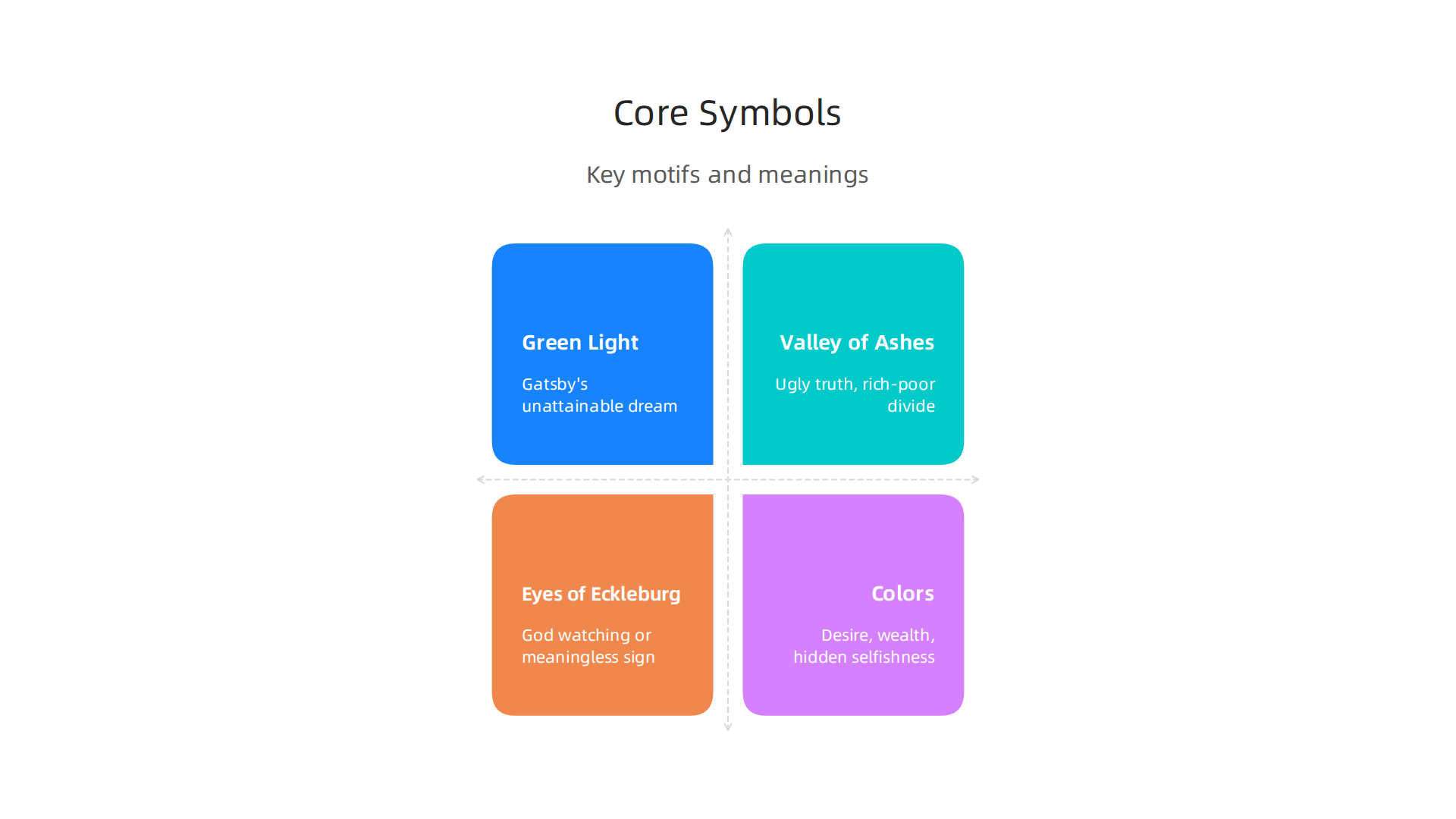
Fitzgerald packed his story with images that stick with you long after you close the pages. And here is the thing: these symbols still matter today, maybe more than ever.
Let us start with the green light at the end of Daisy’s dock. Gatsby stares at it across the water, reaching out like he can grab hope itself. That green light stands for his dream: Daisy, money, a future that never comes. According to SparkNotes, the green light represents Gatsby’s hopes and dreams for the future, tied to the American dream that always stays just out of reach. Think about your own life. How often do we chase something we think will fix everything, only to find it does not? In the digital age, the green light might be that next promotion, a perfect Instagram feed, or the dopamine hit of a notification. We keep reaching, but the goalpost keeps moving.
Then there is the Valley of Ashes. It is a grey, dead stretch of land between the rich neighborhoods and New York City. This place shows the ugly truth behind the glittering parties. The rich get richer by stepping on the poor, and the ashes represent all the people left behind. Fitzgerald was not subtle here. He wanted readers to see that the American dream comes with a huge cost. The eyes of Doctor T. J. Eckleburg stare over that valley from a faded billboard. Some readers think those eyes are God watching a broken world. But SparkNotes points out that the novel never says that for sure. The meaning comes from the characters. George Wilson sees God in those eyes. For everyone else, the eyes are just a sign that means nothing. That is a scary thought. In a world without clear meaning, we have to create our own.
Fitzgerald also used colors to layer meaning. Green means desire and jealousy. Gold means old money. White hides Daisy’s selfishness behind a mask of innocence. The colors in The Great Gatsby symbolize many things, as Study.com explains, from greed to class conflict. Fitzgerald did not pick colors randomly. He wanted every detail to pull you deeper into the story.
If you love digging into how stories work, you might enjoy exploring the story elements every novel needs. Understanding symbols like these makes reading richer and more fun. And the green light? Today it is the endless scroll, the next trend, the thing we think will finally make us happy. Fitzgerald knew that chase never ends. That is why the great gatsby book feels so modern. It is not just a story about the 1920s. It is a story about all of us, still chasing a light that disappears when we get close.
The Great Gatsby in Modern Culture: Adaptations, References, and Parallels
Gatsby keeps showing up everywhere. That is the thing about a story that gets under your skin. It refuses to stay in the past.
The most famous version is Baz Luhrmann’s 2013 film starring Leonardo DiCaprio. It made over $353 million worldwide, according to Wikipedia, and won two Oscars. The film drew huge interest from younger women, even though the story is about middle-aged characters from a hundred years ago. The LA Times reported that audiences were surprisingly young, with many connecting to Gatsby’s world of excess and longing.
Luhrmann took a big risk by making the film in 3D and filling it with modern hip-hop. Jay-Z’s soundtrack bridged the 1920s and the 2010s, making the emotions feel fresh. Not everyone loved it. Some critics said the style drowned out the substance. But Fitzgerald’s granddaughter said the author would have been proud. And the numbers do not lie. The movie became Luhrmann’s biggest hit ever.
But Gatsby is not just in theaters. It is in your Spotify playlist, your Instagram feed, and your wardrobe. The 2013 soundtrack turned songs like "Young and Beautiful" by Lana Del Rey into modern anthems of desire and loss. Fashion brands brought back flapper dresses and art deco patterns. And internet memes? Gatsby throwing his shirts, the green light, the party scenes, they all became shorthand for showing off, chasing unattainable dreams, or pretending to be someone you are not.
That last part hits close to home in 2026. Think about social media. We carefully pick our best photos, craft the perfect caption, and build a persona that looks flawless. Sound familiar? Gatsby did exactly that. He threw huge parties, wore fancy suits, and drove a flashy car, all to impress Daisy. Today we do the same with filters and curated feeds. The performance is the same, just on a different stage.
Economic inequality is another parallel that stings. The 1920s had the Roaring Twenties where a few got super rich while many struggled. Sound like today? The tech billionaires, the housing crisis, the gap between the haves and the have-nots. The Valley of Ashes looks a lot like the abandoned towns and forgotten neighborhoods of modern America.
Fitzgerald wrote a story that keeps finding new life because it captures something true about human nature. We want what we cannot have. We pretend to be something we are not. We chase a green light that keeps moving.
If you enjoy exploring how classic stories stay relevant, you might also like the Annihilation book and how it reimagines modern classic themes. Finally, if you want to join a community of readers and creators who dig into books and ideas together, consider to Join The Newsletter for updates on book discussions, experiments, and ways to connect beyond a single article. Gatsby would probably have signed up. He was always looking for the next connection.
Lessons from Gatsby for Personal Growth and Reflection
So here is the real question. What can Gatsby teach you about your own life? The book is not just a tragedy about a rich guy with bad luck. It is a mirror. And if you look closely, you might see things you wish you could change.
The biggest warning in the story is about chasing a dream that already died. Gatsby spent five years trying to recreate the past. He bought the mansion, threw the parties, and changed his whole identity, all to win back Daisy. But Daisy was never the same person he remembered. And neither was he. That is the sad truth about fixating on an idealized past. It steals the present.
You probably do not throw parties for hundreds of strangers. But think about it. How often do you replay old memories in your head? How often do you wish you could go back and fix something, or get someone to love you the way they used to? That is your own green light. And it keeps you stuck.
Another lesson from the book is about the cost of pretending. Gatsby built a fake identity. He changed his name, lied about his past, and surrounded himself with people who did not really know him. In the end, he died alone. Modern research on the power of stories shows that reading fiction can help you understand yourself better. It can improve self-esteem, self-awareness, and feelings of self-efficacy, as noted in the discussion of bibliotherapy for personal growth. The act of reflecting on characters like Gatsby gives you a safe way to examine your own choices.
So what would it look like to live more authentically? Here are a few questions to sit with after you close the book.
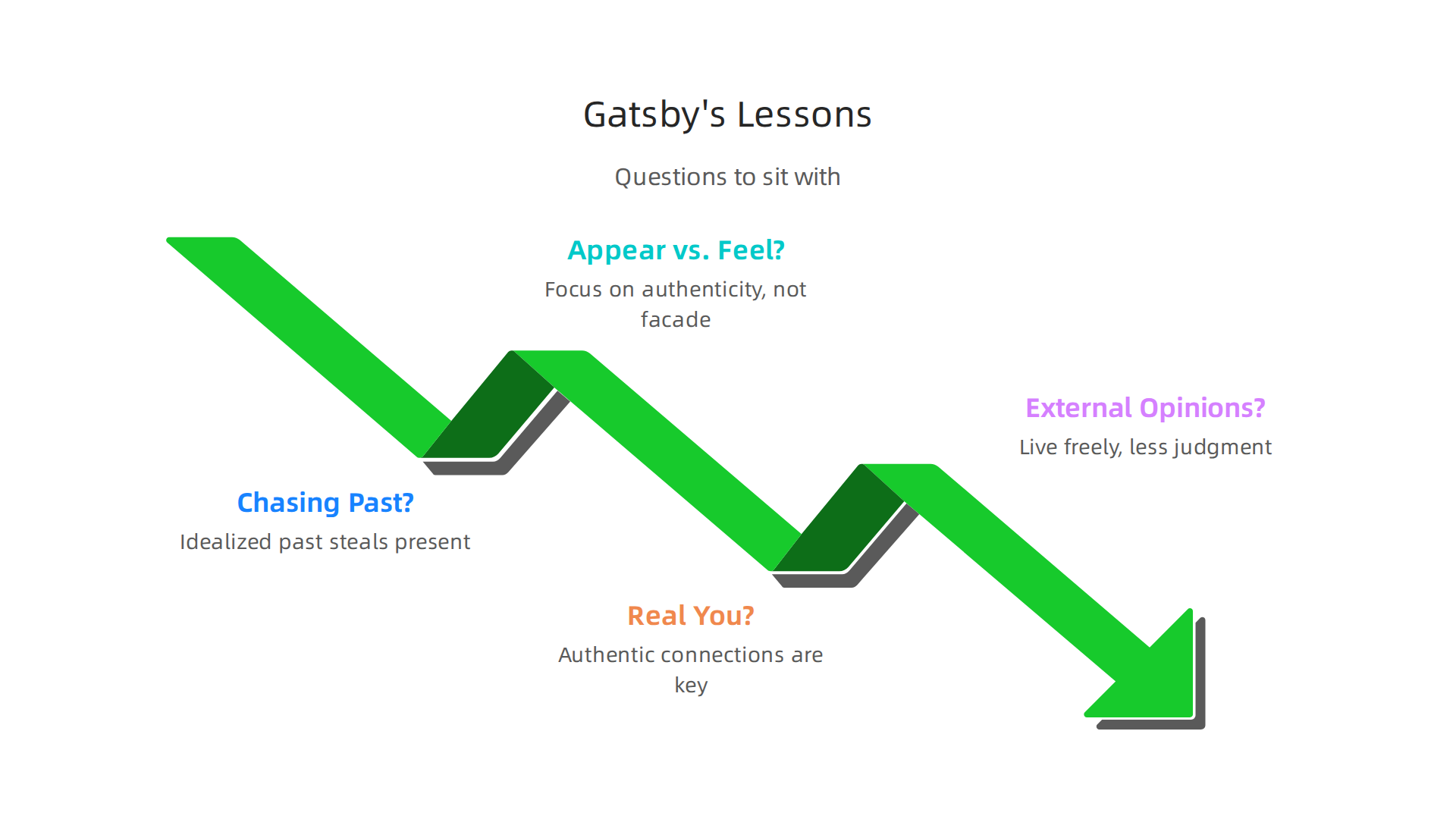
- Are you chasing something or someone because of who they were, not who they are now?
- How much energy do you spend on looking good versus feeling good?
- Who in your life really knows the real you, not the polished version?
- What would you do differently if you stopped caring about what others think?
These questions are not easy. But they are worth asking. The whole point of reading stories like this one is to grow a little smarter about your own life. You can also explore other resources that help with building connection and reducing self-doubt, such as mental health synonyms that build connection.
If you are ready to move from passive reflection into real action, consider trying something small this week. Pick one thing you have been hiding or pretending about, and share it with someone you trust. That is a small win. And small wins add up.
The Ridiculous universe was built for people who want to do more than just scroll. It is for people who want to participate, create, and connect in meaningful ways. If that sounds like you, you might want to Join An Experiment and turn reflection into real momentum.
Gatsby never got the chance to stop pretending. You do.
How to Deepen Your Reading Experience: Discussion, Community, and Further Exploration
You have finished the last page of the book. Now comes the best part. The conversation. Reading The Great Gatsby on your own is powerful. But talking about it with others? That is where the lessons really sink in.
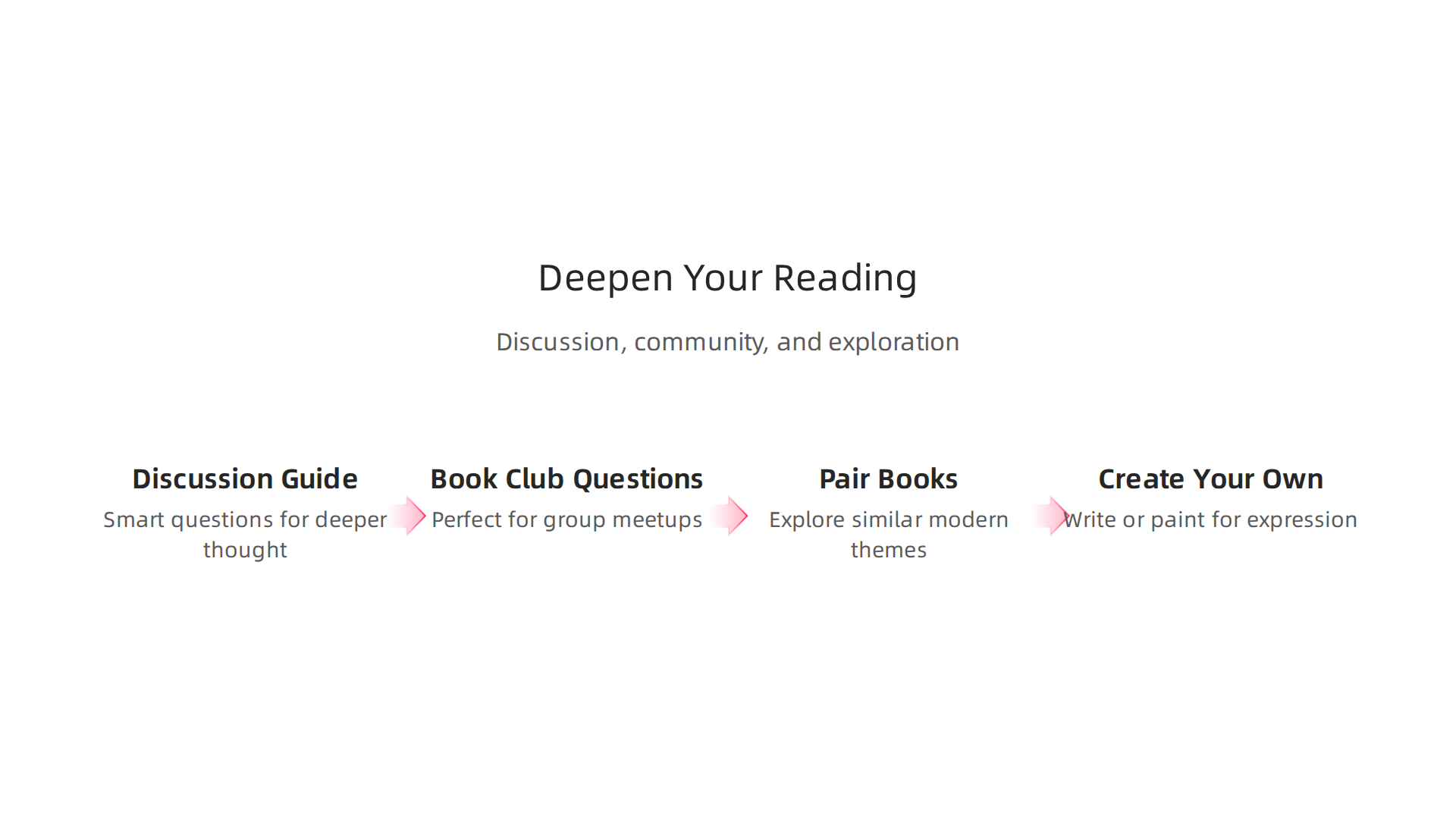

A good place to start is with a discussion guide. These will give you smart questions that go beyond "Did you like it?" You can find a set of thoughtful questions in the Great Gatsby (Fitzgerald) discussion guide from LitLovers. They ask things like "Is Jay Gatsby great?" and "What does the green light really mean?" Questions like these push you to think deeper.
If you want a printable version to bring to a meetup, check out the book club questions for The Great Gatsby from Bookclubs. These are perfect for group settings.
You might also want to pair this classic with a more recent book for a richer experience. Think about novels that explore similar themes like identity, obsession, or the cost of the American Dream. Books like Twilight the book might seem far off, but they also deal with longing and idealizing someone. Or try Babel book for a modern take on power and belonging. If you are looking for a physical copy, you can find a book pdf online, but nothing beats holding a real one in your hands.
Another way to go deeper is to create something of your own. Write a short story from Daisy’s point of view. Paint a picture of the ash heaps. Or start a small group experiment where each person reads a different character and discusses their motivations. The ultimate book club guide can help you set up a group that stays fun and focused.
If you want to improve your own writing skills, take a look at our post on 10 story elements every novel and short story needs. It will help you see how Fitzgerald built his masterpiece.
Stories work best when they are shared. That is why we invite you to stay connected with a community that values reflection, creativity, and real participation. Ready for more? Join The Newsletter and get fresh ideas delivered to your inbox. No pretension. Just good books and honest conversations.
Summary
This article explains why The Great Gatsby still resonates nearly a century after its publication by connecting Fitzgerald’s story to modern life. It walks through the novel’s critique of the American Dream, the social-class divisions that mirror today’s inequality, and the emotional core of characters like Gatsby, Daisy, Nick, and Tom. You’ll get clear readings of the book’s major symbols—the green light, the eyes of Dr. T. J. Eckleburg, the Valley of Ashes—and see how those images map onto social media, ambition, and performance culture. The piece also covers notable adaptations and cultural echoes, offers practical lessons for personal reflection and authenticity, and suggests ways to deepen your reading through discussion guides, writing prompts, and related books. After reading, you’ll have concrete questions to think about, resources to lead conversations, and ideas to apply Gatsby’s themes to your own life.